
Dental Implants vs Bridges: Which Is Right for You?
Losing a tooth is one of those things you do not really think about until it happens to you. Suddenly there is a gap, and along with it comes a string of questions. Will it affect how I eat? Will people notice when I smile? And most pressing of all, what is the best way to fix it?
If you have been doing your research, you have probably landed on the two most common solutions for a missing tooth: a dental implant or a dental bridge. Both are excellent, well-established treatments, and both can give you back a complete, confident smile. They simply go about it in very different ways. The right choice depends on your mouth, your budget, your timeline, and your long-term goals.
At Mount Royal Dental Centre, we help patients of Calgary weigh this decision every week, so we put together this guide to walk you through it the same way we would in the chair. By the end, you will understand exactly how implants and bridges differ, what each one costs, and which option tends to suit which patient.
A quick look at each option
Before we compare them side by side, it helps to understand what each treatment actually involves, because the difference in approach is what drives almost every other difference in cost, comfort, and longevity.
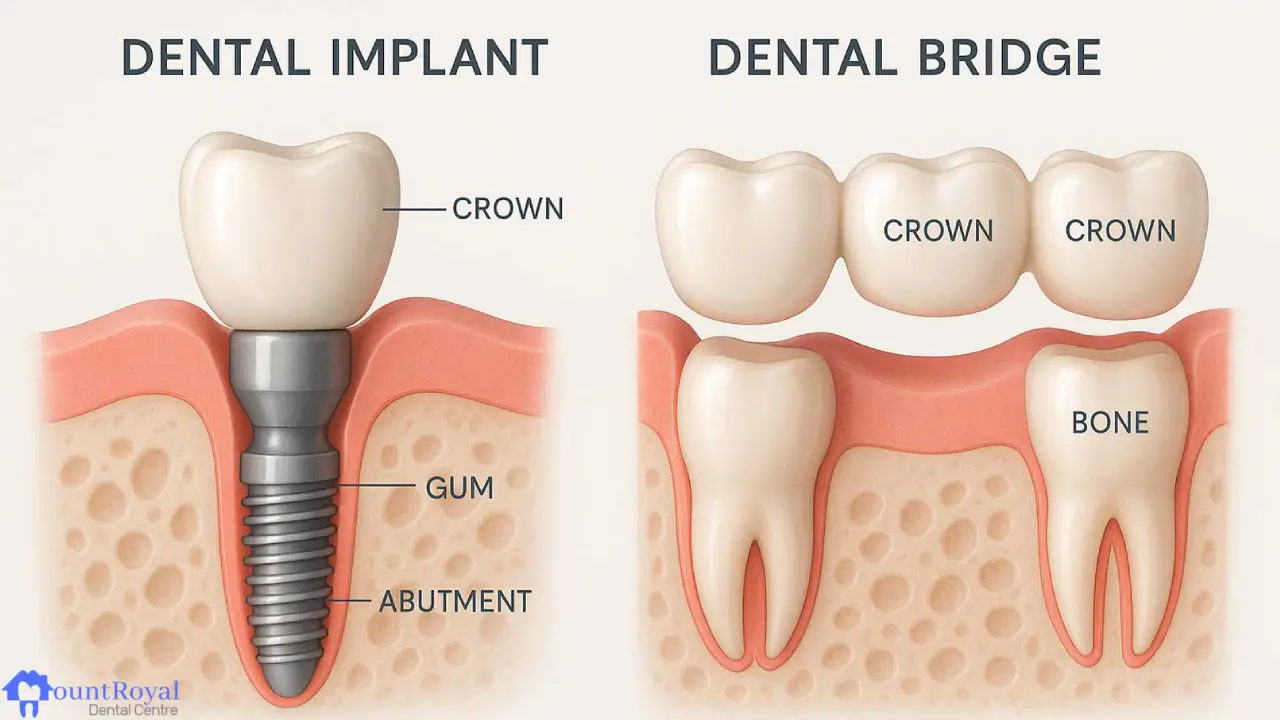
A dental implant replaces the entire tooth, root and all. A small titanium post is surgically placed into your jawbone, where it gradually fuses with the bone over a few months and becomes a sturdy artificial root. Once it has healed, a custom crown is attached on top. The result is a standalone replacement tooth that does not rely on any of your other teeth for support.
A dental bridge takes a different path. Instead of replacing the root, it literally bridges the gap by anchoring a false tooth, called a pontic, to the natural teeth on either side. Those neighbouring teeth are filed down and capped with crowns, and the replacement tooth is fused between them. A bridge sits on top of the gum rather than inside the bone, so there is no surgery involved.
That single distinction, whether you are replacing the root or spanning the gap, is the key to understanding everything that follows.
Dental implants vs. bridges: the head-to-head comparison
Let us look at the factors that matter most when you are making this decision.
The procedure and the timeline
A bridge is the faster of the two. In most cases the process is finished within two or three weeks and a couple of appointments, because there is no surgery and no waiting for bone to heal. If you want your gap filled quickly, a bridge has a clear head start.
An implant asks for more patience. Because the post needs to fuse with your jawbone in a process called osseointegration, the full treatment usually unfolds over several months. It is not painful time, and you are not without a tooth the whole way through, but it is a longer commitment. For many people the wait is worth it, yet it is an honest trade-off to keep in mind.
Longevity and durability
This is where implants pull ahead in a big way. A well-placed dental implant is designed to last for decades, and very often a lifetime, with nothing more than good oral hygiene and regular check-ups.
A bridge, by contrast, typically lasts somewhere in the range of ten to fifteen years before it needs to be replaced. That does not make it a bad investment, but it does mean you should plan for the cost to come around again at some point. Over a thirty or forty year horizon, an implant placed once can easily outlast two or even three bridges.
Effect on your other teeth
Here is a factor that does not show up on a price tag but matters a great deal for your long-term health. To place a traditional bridge, the dentist has to file down the two healthy teeth on either side of the gap so they can hold the crowns. Those teeth are permanently altered, and once enamel is removed it does not grow back.
An implant leaves your neighbouring teeth completely untouched. It stands on its own, which means you are not sacrificing healthy tooth structure to solve the problem of a missing tooth. If the teeth beside your gap are healthy, many dentists see this as a strong point in favour of implants.
Bone health
When you lose a tooth, the jawbone underneath it slowly begins to shrink, because it no longer has a root stimulating it. This is one of the quieter consequences of a missing tooth, and over years it can change the shape of your face and the fit of nearby dental work.
An implant is the only one of the two options that addresses this directly. Because the titanium post acts like a natural root, it keeps the bone stimulated and helps preserve it. A bridge sits above the gum and does nothing for the bone beneath the gap, so that gradual shrinkage continues. If protecting your jawbone over the long term is a priority, this is a meaningful difference.
Comfort, feel, and appearance
Both options look natural these days, and a well-made bridge can be beautifully matched to your smile. The difference is more about feel. Because an implant is anchored in the bone, it feels remarkably close to a real tooth when you bite and chew, with no sense of anything resting on your gums. Bridges feel comfortable and secure too, but some patients notice the difference, especially around the gum line where the pontic meets the tissue.
Maintenance
An implant is cared for just like a natural tooth, with regular brushing and flossing. A bridge needs a little extra attention, because you have to clean underneath the pontic where food can collect, often using a special floss threader or a small interdental brush. Neither is difficult, but the bridge does ask for one more step in your daily routine.
A side-by-side summary
| Factor | Dental Implant | Dental Bridge |
| Replaces the tooth root | Yes | No |
| Surgery required | Yes | No |
| Treatment timeline | Several months | A few weeks |
| Typical lifespan | Decades, often a lifetime | About 10 to 15 years |
| Affects neighbouring teeth | No | Yes, they are filed down |
| Protects jawbone | Yes | No |
| Upfront cost (Calgary) | $3,000 to $6,500 | $2,000 to $4,000 |
| Daily care | Like a natural tooth | Needs cleaning under the pontic |
What about the cost?
For most people, cost is a deciding factor, and on paper the bridge is the more affordable option upfront. In Calgary, a dental bridge typically ranges from about $2,000 to $4,000, while a complete single tooth implant usually falls between $3,000 and $6,500.
The story changes, though, when you look beyond the first invoice. Because a bridge generally needs replacing every ten to fifteen years, its costs tend to recur, whereas an implant placed once can last a lifetime. When you spread the numbers across the decades, the implant often becomes the more economical choice, even though it asks for more at the start.
So which one is right for you?
There is no single winner here, because the best choice genuinely depends on your situation. That said, some clear patterns tend to emerge.
A dental implant is often the better fit if you want the longest-lasting solution, if the teeth beside your gap are healthy and you would rather not have them filed down, if preserving your jawbone matters to you, and if you are comfortable with a longer treatment timeline in exchange for a result that can last a lifetime.
A dental bridge can be the smarter choice if you want to restore your smile more quickly, if you prefer to avoid surgery, if the upfront cost is your primary concern, or if the neighbouring teeth already have large fillings or crowns and could benefit from being capped anyway.
In reality, the only way to know for certain is an examination. Factors like your jawbone density, your gum health, the condition of the surrounding teeth, and your overall health all play a part. During a consultation, we look at all of these together and give you a clear, honest recommendation rather than a one-size-fits-all answer.
Replacing a missing tooth in Calgary
Whichever direction you lean, the most important thing is not to leave a gap untreated for too long, because the longer a missing tooth goes unaddressed, the more the surrounding teeth shift and the more the bone beneath shrinks, which can limit your options later.
At Mount Royal Dental Centre, we offer both dental implants and dental bridges right here in the Beltline, and we are currently accepting new patients. We will walk you through every option, explain the costs clearly, and help you choose the solution that fits your smile and your life. You can learn more on our dental services page or simply reach out and we will take it from there.
Frequently asked questions
Are dental implants better than bridges?
Is a bridge cheaper than an implant?
Do dental bridges damage the teeth next to them?
How long does each option last?
Can I switch from a bridge to an implant later?
Ready to fill the gap?
If you are deciding between a dental implant and a bridge in Calgary, we would love to help you make a confident, well-informed choice. Book a consultation and we will examine your smile, explain your options, and give you a clear, personalized recommendation with transparent pricing.
Table of Contents