
How to Handle a Knocked-Out Tooth Before You Reach the Dentist

A knocked-out tooth can happen in seconds. Whether it is caused by a fall, a sports injury, or an unexpected accident, losing a tooth is a frightening experience that often leaves people unsure of what to do next. The good news is that a knocked-out tooth can often be saved if you act quickly. Knowing the right first-aid steps and contacting an emergency dentist as soon as possible can make all the difference in successfully reattaching the tooth.
What you do in the minutes after a tooth is knocked out can make the difference between saving it and losing it for good. Unfortunately, most people are never taught the proper steps to take during a dental emergency. In this guide, you’ll learn exactly what to do if a tooth gets knocked out, how to handle and store the tooth safely, which mistakes to avoid, and when to contact an emergency dentist in Calgary. Taking a few minutes to read this now could help you stay calm and act quickly if the unexpected ever happens.
At Mount Royal Dental Centre, we provide emergency dental care for patients throughout Calgary. One of the most important things we want our community to know is that a knocked-out tooth is a true dental emergency where every minute counts. Fast action and prompt treatment can significantly improve the chances of saving your natural tooth.
Why minutes matter with a knocked-out tooth
A knocked-out tooth is one of the most time-sensitive dental emergencies. Unlike a chipped or cracked tooth, a knocked-out tooth has completely come out of its socket, including the root. Dentists refer to this as an avulsed tooth. Once the tooth leaves the mouth, the delicate cells on the root surface that help it reattach begin to dry out and deteriorate.
This is why acting quickly is so important. The sooner a knocked-out tooth is returned to its socket or placed in a suitable storage solution, the better the chances of saving it. Ideally, the tooth should be reinserted within a few minutes of the injury. If that is not possible, getting to an emergency dentist within 30 to 60 minutes can still significantly improve the likelihood of successful reattachment.
The key things to remember are simple: keep the tooth moist and seek emergency dental care as quickly as possible. These steps can make the difference between saving your natural tooth and needing a replacement.
Step by step: what to do if your tooth gets knocked out
These steps apply to a knocked-out adult (permanent) tooth. Baby teeth are handled differently, which we cover further down, so if the tooth belongs to a young child, skip ahead to that section first.
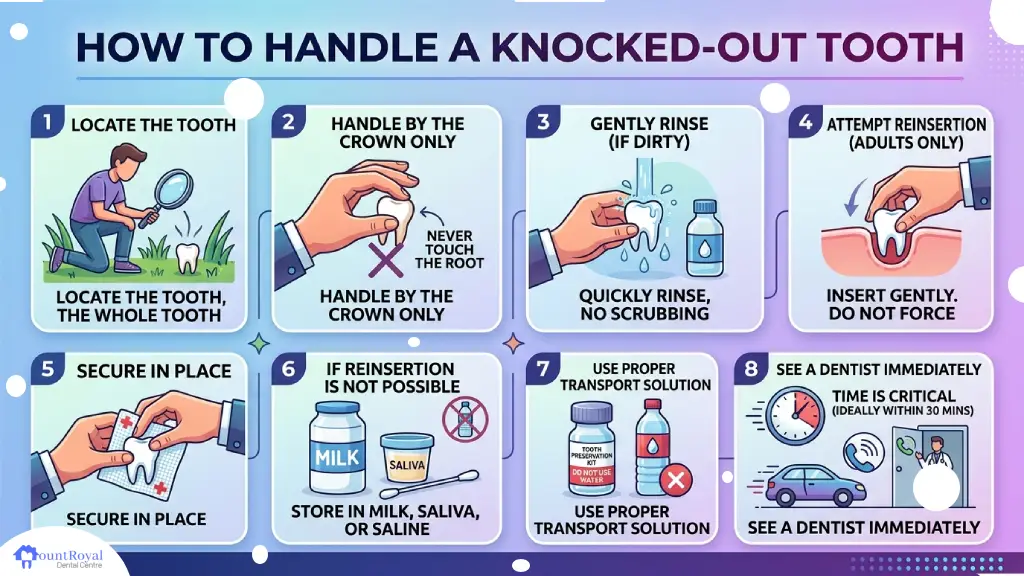
Step 1: Stay calm and find the tooth
A knocked-out tooth can be frightening, but staying as calm as possible will help you take the right steps. The first thing to do is locate the tooth immediately. Every minute matters, and the sooner you find the tooth and begin first aid, the better the chances of saving it.
Step 2: Pick it up by the crown, never the root
Once you have found the tooth, handle it with care. Always pick it up by the crown—the white part of the tooth that is normally visible in your mouth. Avoid touching the root, which is the section that sits below the gumline.
This step is crucial because the root is covered with delicate cells that help the tooth reattach to the bone. Touching, rubbing, or attempting to clean the root can damage these cells and reduce the chances of successfully saving the tooth. Even if the tooth looks dirty, resist the urge to scrub or wipe it. The less the root is handled, the better the likelihood of a successful reattachment.
Step 3: Gently rinse it only if it is dirty
If the knocked-out tooth has fallen on the ground and is visibly dirty, rinse it gently for a few seconds to remove debris. Milk or sterile saline solution is best, but if neither is available, you can briefly rinse the tooth under cool running water.
Do not scrub it, do not use soap, do not dry it, and do not wrap it in a tissue or paper towel, because all of these damage or dry out the very cells you are trying to protect. If there is any soft tissue clinging to the tooth, leave it alone.
Step 4: Try to place it back in the socket right away
For an adult tooth, the best place for it is back where it came from. Holding it by the crown, gently slide the tooth back into its socket in the correct orientation, facing the same way as the teeth around it.
Once it is in, bite down softly on a clean piece of gauze, a handkerchief, or a napkin to hold it in place. This sounds intimidating, but reinserting the tooth quickly gives it the best possible chance, because the socket keeps it moist and in its natural environment.
Step 5: If you cannot reinsert it, store it properly
If you are unable to place the tooth back into its socket, do not panic. The next priority is keeping the tooth moist until you can reach an emergency dentist. How you store the tooth can have a major impact on whether it can be successfully saved.
Cold milk is one of the best and most widely available storage options. It helps protect the delicate cells on the root and keeps them viable for longer. If you have access to a tooth preservation kit or saline solution, those are also excellent choices.
For adults, another option is to place the tooth inside the mouth between the cheek and gums, where it can stay moist in saliva. However, this should never be done with young children due to the risk of swallowing the tooth.
Most importantly, do not let the tooth dry out. Avoid wrapping it in tissue, paper towels, or cloth, and do not store it in plain water, as water can damage the root cells that are needed for the tooth to reattach successfully. Keeping the tooth moist while getting to an emergency dentist as quickly as possible gives it the best chance of being saved.
Step 6: Get to an emergency dentist within 30 to 60 minutes
Even if you have successfully placed the tooth back in its socket or stored it properly, time is still critical. A knocked-out tooth requires immediate professional care, so contact an emergency dentist as soon as possible and aim to be seen within 30 to 60 minutes of the injury.
If you can, call the dental office before you leave. Let the team know that you have a knocked-out tooth so they can prepare for your arrival and see you as quickly as possible. Those extra minutes can make a meaningful difference in the chances of saving your natural tooth.
For patients in Calgary, seeking emergency dental care right away gives the dentist the best opportunity to reattach and stabilize the tooth successfully. The sooner treatment begins, the better the long-term outcome is likely to be.
The do-not list: common mistakes that cost people their tooth
Knowing what not to do is just as important as knowing what to do, because a few well-meaning instincts can ruin an otherwise savable tooth. Avoid these mistakes:
Do not touch or scrub the root of the tooth. Do not clean the tooth with soap, alcohol, or disinfectant. Do not dry the tooth or wrap it in a tissue or cloth. Do not store the tooth in plain tap water. Do not hold off on seeing a dentist because the bleeding stopped or the pain eased, since the tooth still needs urgent professional care. And never try to reinsert a baby tooth, which we explain next.
A quick guide to storing a knocked-out tooth
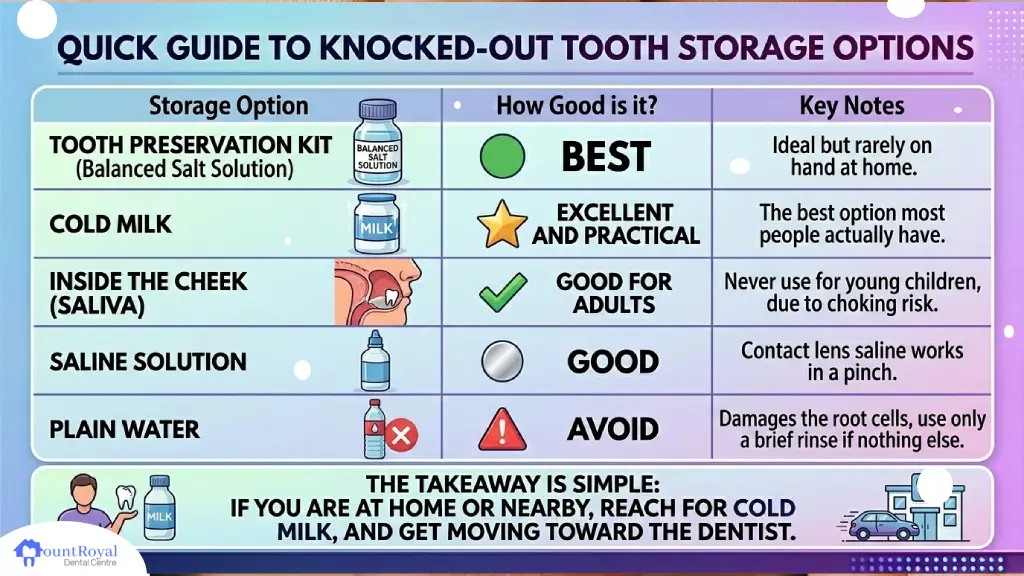
If you cannot put the tooth back in its socket, here is how the common storage options compare, from best to worst.
| Storage option | How good is it? | Notes |
| Tooth preservation kit (balanced salt solution) | Best | Ideal but rarely on hand at home |
| Cold milk | Excellent and practical | The best option most people actually have |
| Inside the cheek (saliva) | Good for adults | Never use for young children, due to choking risk |
| Saline solution | Good | Contact lens saline works in a pinch |
| Plain water | Avoid | Damages the root cells, use only a brief rinse if nothing else |
The takeaway is simple. If you are at home or nearby, reach for cold milk, and get moving toward the dentist.
What if it is a baby tooth?
This is an important distinction for parents. If a child knocks out a baby tooth, you should not try to place it back into the socket. Unlike adult teeth, a baby tooth is not reinserted because doing so can harm the developing permanent tooth underneath it, which may affect how the adult tooth grows in later.
However, this does not mean you should ignore it. It is still important to contact a dentist as soon as possible so they can examine the area, check for any damage to the gums or surrounding teeth, and guide you on what to expect as the permanent tooth develops.
If you are unsure whether the tooth is a baby tooth or a permanent one, it is always best to call a dental clinic right away. A dentist can help you identify it and advise you on the next steps over the phone.
What happens when you reach the dentist
Once you arrive at the dental clinic, the dental team will act quickly to assess the situation. If the tooth has already been placed back in the socket, they will check its position and stabilize it to make sure it stays in place.
If the tooth has not been reinserted yet, the dentist will gently clean the socket and, when possible, place the tooth back into its original position. To help it heal properly, the tooth is usually held in place with a small, flexible splint attached to the neighbouring teeth. This keeps it stable while the surrounding ligament has time to heal and reattach.
Follow-up care is also an important part of treatment. Depending on how long the tooth was out and how the root responds, a root canal may be needed later to prevent infection. You will also be scheduled for follow-up visits so the dentist can monitor healing and make sure everything is progressing as expected.
The important thing to remember is that you do not need to manage this process on your own. Your role is to protect the tooth and get to the dentist as quickly as possible. Once you arrive, the dental team will take care of the rest.
If the tooth cannot be saved
In some cases, even with fast action and proper care, a knocked-out tooth cannot be saved. This usually happens if too much time has passed before treatment or if the injury to the tooth or root is too severe.
If this happens, it is not the end of your smile. Modern dentistry offers reliable tooth replacement options that look natural and restore normal function.
The two most common solutions are dental implants and dental bridges. Dental implants are a long-term option that replace both the tooth and root, while dental bridges use the surrounding teeth for support to fill the gap. The right choice depends on your oral health, budget, and long-term goals.
If you want to understand the differences in more detail, you can explore our guide on dental implants versus bridges. If cost is a concern, our breakdown of dental implants in Calgary can also help you plan your next steps.
The most important thing to remember is that losing a tooth is manageable. With the right treatment plan from a dentist, you can restore your smile, function, and confidence.
How to prevent a knocked-out tooth
The best way to deal with a knocked-out tooth is to avoid it happening in the first place. Most cases are caused by sports injuries or accidental falls, which means a few simple precautions can significantly reduce the risk.
If you or your child plays contact sports like hockey, basketball, football, or rugby, wearing a properly fitted mouthguard is one of the most effective ways to protect your teeth. A custom mouthguard made by your dentist offers better fit, comfort, and protection than store-bought options, helping absorb impact and reduce the chance of teeth being knocked out.
Everyday habits also matter. Avoid using your teeth to open packages or bottles, be careful on slippery or uneven surfaces, and maintain regular dental check-ups. Healthy teeth and gums are better supported and more resistant to injury than neglected ones, so ongoing dental care also plays an important role in prevention.
Emergency Dentist in Calgary: We Are Here When You Need Us
A knocked-out tooth is a true dental emergency, and having a clinic you can contact right away can make a real difference. At Mount Royal Dental Centre, we provide emergency dental care and do our best to see patients with urgent dental problems as quickly as possible, including same-day appointments whenever available. We are also open on Saturdays, which can be especially helpful when an injury happens on the weekend and most clinics are closed.
If you or a loved one has knocked out a tooth, follow the steps outlined above, keep the tooth moist, and contact us immediately so we can prepare for your arrival. You can also learn more about our emergency dental services and the full range of care we offer on our services page.
Important: If the injury involves severe bleeding that does not stop, a suspected broken jaw, head injury, loss of consciousness, or any other serious medical concern, please call 911 or go to the nearest emergency room immediately. A knocked-out tooth is urgent, but your overall safety always comes first.
Frequently asked questions
Can a knocked-out tooth be saved?
How long do I have to save a knocked-out tooth?
Can I put my tooth back in myself?
What should I store a knocked-out tooth in?
Is a knocked-out tooth a real emergency?
What if my child knocks out a baby tooth?
Be ready before it happens
Dental emergencies never come at a convenient time, but knowing what to do turns a panicked moment into a manageable one. Save our number in your phone now, so that if you ever face a knocked-out tooth, help is only a quick call away.
Call us at (587) 417-2939 (call or text) or (403) 453-2800, or book an appointment online. Mount Royal Dental Centre, 903 15 Ave SW, Calgary, AB T2R 0S2, proudly serving the Beltline and central Calgary.
This article is for general information only and does not replace professional dental or medical care. If you are experiencing a dental emergency, contact a dentist immediately, and for any serious or life-threatening injury, call 911.
Table of Contents