
Impacted Wisdom Teeth: Signs, Causes and When They Need Removal
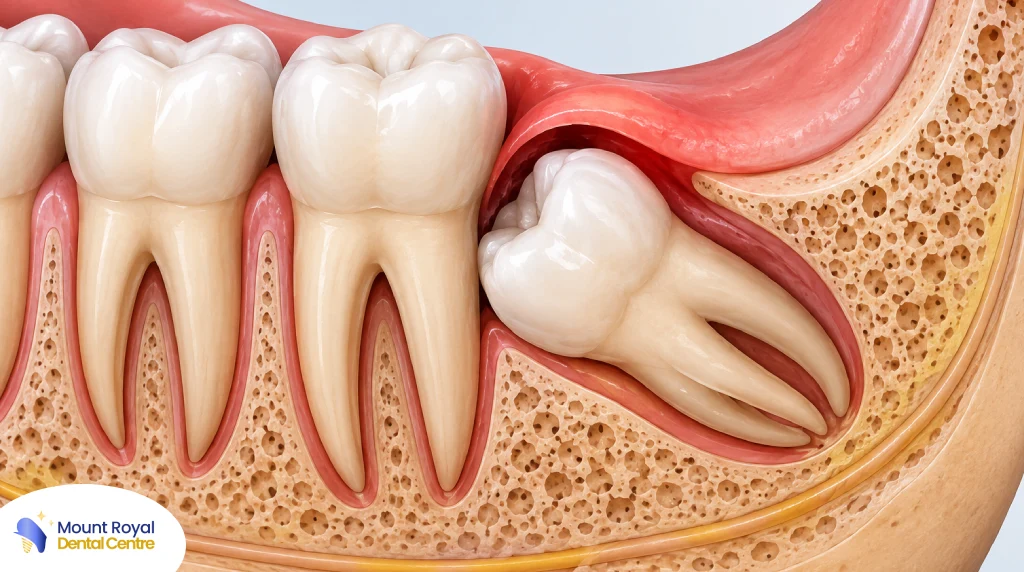
Wisdom teeth usually appear in the late teens or early twenties, when most of the other teeth are already fully developed. Because there may not be enough room at the back of the mouth, a wisdom tooth can become stuck beneath the gum or jawbone. This is known as an impacted wisdom tooth.
Some impacted wisdom teeth never cause noticeable problems. Others can lead to pain, infection, decay, or damage to nearby teeth. The only reliable way to determine whether a wisdom tooth is impacted is through a dental examination and, when needed, an X-ray.
What is an impacted wisdom tooth?
Wisdom teeth are the third and final set of molars. They usually begin to come through between the ages of 17 and 25.
When there is not enough room for a wisdom tooth to erupt normally, it may remain trapped beneath the gum or jawbone. It may also grow at an unusual angle and press against the molar in front of it.
An impacted wisdom tooth can be:
- Partially erupted through the gum
- Completely buried beneath the gum
- Trapped in the jawbone
- Tilted forward, backward, or sideways
Impaction is usually related to the amount of available space in the jaw and the position in which the tooth develops.
Fully impacted vs. partially impacted wisdom teeth
Not every impacted wisdom tooth looks or behaves the same way.
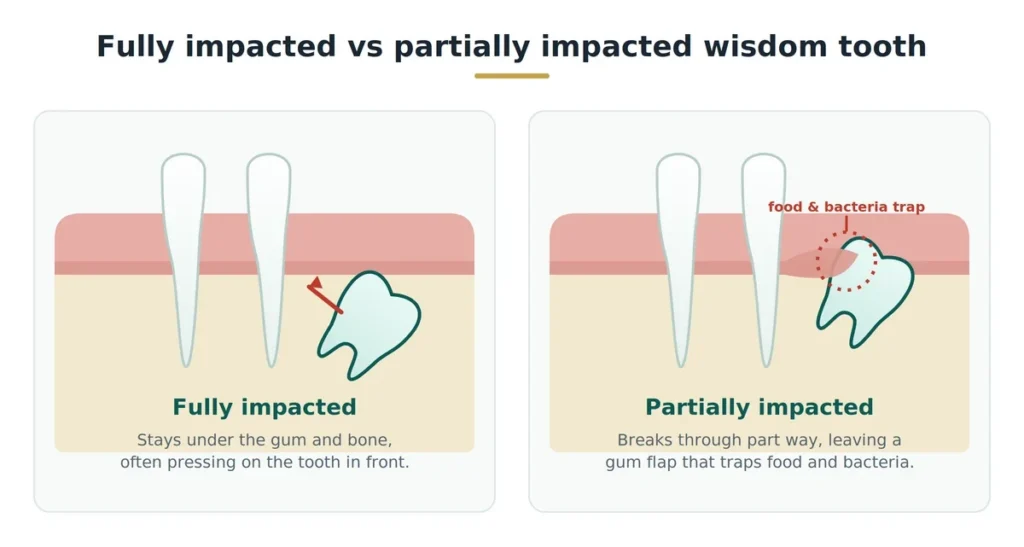
Partially impacted wisdom tooth
A partially impacted wisdom tooth has only broken through the gum partway. A portion of the tooth remains covered by gum tissue.
This can create a small space where food and bacteria become trapped. Because the area can be difficult to clean, partially erupted wisdom teeth are particularly prone to gum inflammation and infection.
Fully impacted wisdom tooth
A fully impacted wisdom tooth remains completely below the gum line. It may be held back by gum tissue or the surrounding jawbone.
Some fully impacted teeth remain symptom-free for years. However, they can still press against nearby teeth or their roots, which is why dental X-rays are important when assessing wisdom teeth.
Common types of wisdom tooth impaction
Dentists may also describe an impacted wisdom tooth according to its direction:
- Mesial impaction: The tooth tilts forward toward the front of the mouth. This is the most common type.
- Vertical impaction: The tooth is positioned upright but remains stuck beneath the gum or against surrounding structures.
- Horizontal impaction: The tooth lies on its side and may push directly against the molar in front of it.
- Distal impaction: The tooth angles backward toward the rear of the jaw.
Why do wisdom teeth become impacted?
The most common reason is simply lack of space.
If the jaw does not have enough room for another large molar, the wisdom tooth may not be able to move into a normal position. Other factors that can contribute to impaction include:
- A small or narrow jaw
- Existing dental crowding
- An unusual angle of growth
- Dense bone or thick gum tissue that prevents normal eruption
There is usually nothing you could have done to prevent an impacted wisdom tooth. The position of your jaw and the way your teeth develop play the biggest role.
Signs and symptoms of an impacted wisdom tooth
Some impacted wisdom teeth do not cause symptoms and are discovered during a routine dental X-ray. Others can cause noticeable discomfort around the back of the mouth.
Common signs include:
- Pain or a dull ache at the back of the jaw
- Red, swollen, or tender gums behind the last molar
- Swelling in the jaw or cheek
- Persistent bad breath or a bad taste
- Jaw stiffness or difficulty opening your mouth
- Headaches or earaches on the same side
It is important to remember that pain does not always mean a wisdom tooth is impacted, and an impacted wisdom tooth does not always cause pain.
If you notice symptoms around your wisdom teeth, a dental assessment can help determine what is actually causing them.
Infection around a partially erupted wisdom tooth
One of the most common complications of a partially erupted wisdom tooth is pericoronitis.
Pericoronitis occurs when gum tissue remains over part of the tooth. Food and bacteria can become trapped underneath the gum flap, causing inflammation and infection.
Symptoms can include:
- Swelling around the wisdom tooth
- Throbbing pain
- Bad taste or bad breath
- Pus around the tooth
A dentist may clean the area and, when appropriate, prescribe antibiotics to help control an infection. However, if the wisdom tooth continues to cause repeated infections, removal may be recommended because the underlying area remains difficult to clean.
If you develop fever, spreading facial swelling, or difficulty swallowing, seek same-day dental care.
Having Wisdom Tooth Problems?
Pain, swelling, or discomfort around your wisdom teeth may be a sign of impaction. Our Calgary dental team can examine your wisdom teeth, assess your oral health, and recommend the right treatment to prevent further complications.
Can an impacted wisdom tooth damage nearby teeth?
Yes. An impacted wisdom tooth can sometimes affect the healthy molar directly in front of it.
A wisdom tooth growing at an angle may place pressure against the neighbouring tooth. Over time, this can contribute to enamel damage, root damage, decay, or gum disease.
The area between the two teeth can also be particularly difficult to clean, increasing the risk of dental problems.
In less common cases, a cyst can develop around an impacted wisdom tooth. While these cysts are uncommon, they can affect surrounding bone, nerves, or teeth if they are left untreated.
How is an impacted wisdom tooth diagnosed?
A wisdom tooth assessment begins with an examination and discussion about any symptoms you have noticed.
Your dentist will look for signs such as swelling, tenderness, infection, or a partially erupted tooth.
Because much of an impacted wisdom tooth may be hidden beneath the gum or bone, an X-ray is often needed to understand its position.
Dental imaging can show:
- The position and angle of the wisdom tooth
- How much room is available
- Its relationship with nearby teeth
- Its proximity to nerves in the lower jaw
- Its relationship to the sinuses around the upper teeth
At Mount Royal Dental Centre, digital X-rays may be used when needed during a wisdom tooth assessment so treatment recommendations are based on the actual position of the tooth.
When does an impacted wisdom tooth need to be removed?
Not every impacted wisdom tooth needs to be removed.
If a wisdom tooth is healthy, stable, symptom-free, and easy to keep clean, your dentist may recommend monitoring it through regular dental visits and occasional X-rays.
Removal may be recommended when there is:
- Ongoing pain or pressure
- Repeated infections or pericoronitis
- Damage to a neighbouring tooth
- Decay or gum disease
- A cyst or other concerning change visible on an X-ray
The timing of treatment can also matter. Wisdom teeth are often easier to remove during the late teens and early twenties, before the roots are fully developed and the surrounding bone becomes denser.
However, there is no single age or rule that applies to everyone. Your dentist can determine whether removal or monitoring is appropriate based on your examination and X-rays.
What happens during wisdom tooth removal?
Wisdom tooth removal varies depending on the position and complexity of the tooth.
A straightforward extraction may be relatively quick, while an impacted or deeply positioned tooth may require a more involved procedure.
Local anaesthetic is used to keep you comfortable during the extraction. Some tenderness, swelling, or bruising afterward is normal, particularly during the first few days. Most people continue to improve over the following days, with fuller healing taking longer depending on the complexity of the extraction.
Your dental team will provide aftercare instructions to help support a smooth recovery.
Can all four wisdom teeth be removed at once?
In many cases, all four wisdom teeth can be removed during the same appointment.
Having them removed together can mean going through one recovery period rather than having separate procedures. However, whether this is the right approach depends on the position of the teeth, your oral health, and your individual treatment needs.
Your dentist can explain whether removing them together or in stages makes the most sense for you.
When should you have an impacted wisdom tooth checked?
You should consider a dental assessment if you have:
- Persistent pain at the back of your mouth
- Swollen or tender gums
- Repeated infections around a wisdom tooth
- Difficulty opening your mouth
- A bad taste or persistent bad breath
- Swelling around your jaw or cheek
- Concerns about a wisdom tooth that has not fully erupted
Even if you have no pain, a routine dental examination and X-ray can identify an impacted wisdom tooth before it causes problems.
Wisdom tooth assessment and removal in Calgary
If you are concerned about an impacted wisdom tooth, Mount Royal Dental Centre provides wisdom tooth assessments and extractions in Calgary’s Beltline.
Our clinic is open 7 days a week, with same-day appointments available. We also offer direct billing to all insurance plans.
Book an assessment online or call or text (587) 417-2939.
Frequently Asked Question
Does wisdom teeth removal hurt?
Can I leave my wisdom teeth alone if they do not hurt?
How long is the recovery?
How long does the procedure itself take?
Can all four wisdom teeth be removed at once?
What can I eat after wisdom teeth removal?
Is swelling after the procedure normal?
What is dry socket, and how do I avoid it?
Can wisdom teeth cause headaches or ear pain?
Do I need a referral to have my wisdom teeth assessed?
A note from our dental team
This article is for general information and is not a substitute for a personal dental examination. Whether a wisdom tooth is impacted, and whether it should be removed, can only be determined by a licensed dentist after an in-person assessment and appropriate imaging.
Table of Contents
