
Dental Insurance in Canada: What Treatments Are Usually Covered in 2026
Understanding your dental coverage should not feel like decoding a foreign language, yet for many Canadians it does. You know you have some kind of plan, or you have heard about government coverage, but when it comes to what is actually paid for, things get fuzzy fast.
This guide clears it up. We will walk through how dental insurance generally works in Canada in 2026, what treatments are usually covered, what tends to be left out, and how the Canadian Dental Care Plan fits into the picture. The goal is simple, which is to help you feel confident about your coverage so you can plan your care without unwelcome surprises. Please keep in mind that this is general information, and the details of your own plan can vary, so always confirm specifics with your provider.
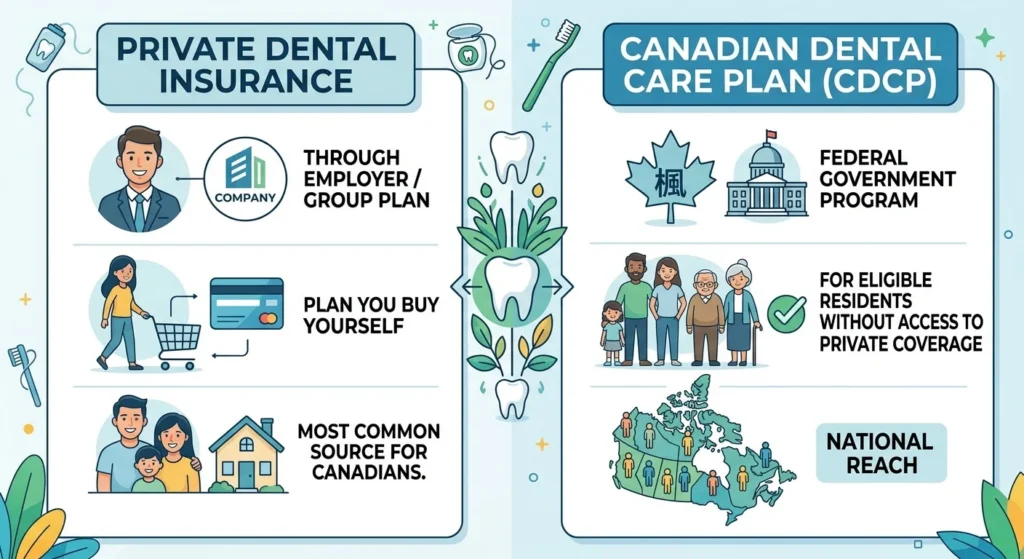
Two kinds of dental coverage in Canada
Most Canadians get their dental coverage from one of two sources, and it helps to know which applies to you.
The first is private insurance, usually through an employer or a plan you buy yourself. The second is the Canadian Dental Care Plan, a federal program for eligible residents who do not have access to private coverage. These two systems work differently, so we will look at each in turn.
How private dental insurance usually works
Private and employer dental plans typically sort treatments into categories, and each category is covered at a different percentage. While every plan is different, the general structure across Canada looks fairly consistent.
Preventive and diagnostic care
This is the care that keeps problems away, and it is usually the best-covered category, often at 80 to 100 percent. It generally includes routine checkups, professional cleaning, examinations, X-rays, and fluoride treatments.
Insurers cover this generously for a good reason. Regular preventive dental care catches issues early and reduces the need for expensive treatment later, which benefits everyone. If your plan covers little else, it very likely covers this, so it makes sense to use it.
Basic and restorative care
This category covers the everyday repairs, and it is often reimbursed at around 70 to 80 percent, though this varies. It typically includes fillings, simple extractions, and often root canal treatment, along with treatment for gum issues in many plans.
These are the bread-and-butter procedures that most people need at some point, so it is worth knowing your plan’s percentage and any limits before you need the work done.
Major care
Major treatments are the larger, more involved procedures, and they are usually covered at a lower rate, often around 50 percent. This category commonly includes dental crowns, bridges, dentures, and sometimes more complex oral surgery.
Coverage for dental implants varies quite a bit between plans, with some contributing and others excluding them, so this is one to check carefully if you are considering implant treatment.
Orthodontic care
Orthodontic coverage, for treatments like braces and clear aligners, is not included in every plan. When it is offered, it is often covered at around 50 percent up to a lifetime maximum, and some plans limit it to children and teens. If straightening your teeth is on your mind, confirm whether your plan includes orthodontics and what the limits are.
The fine print that trips people up
Beyond the categories, a few plan features shape what you actually pay:
- Annual maximum: Most plans cap how much they will pay in a year, often somewhere in the range of one to two thousand dollars or more. Once you hit it, further costs are yours until the year resets.
- Deductible: Some plans require you to pay a set amount out of pocket before coverage kicks in.
- Waiting periods: Certain plans make you wait before major services are covered.
- Recall frequency: Plans often limit how often they will pay for cleanings and exams, such as every six or nine months.
Knowing these details is the difference between a plan you think you understand and one you actually do.
The Canadian Dental Care Plan in 2026
The Canadian Dental Care Plan, or CDCP, is a federal program that has changed the picture for millions of people who previously had no dental coverage at all. It is administered by Sun Life on behalf of the federal government, and in 2026 it is fully open to eligible residents of all ages.
Good news if you are covered under it. Mount Royal Dental Centre accepts patients with CDCP coverage, so you can receive care with us using your plan.
Who is eligible
To qualify for the CDCP, you generally need to meet a few key conditions. You must be a Canadian resident for tax purposes, have an adjusted family net income under 90,000 dollars per year, have filed your most recent tax return, and, importantly, not have access to private dental insurance.
That last point catches many people off guard. If you have access to dental coverage through an employer, a pension, a spouse’s plan, or a policy you bought, you are not eligible, even if you never use it. Eligibility is based on your most recent tax return, and the plan requires annual renewal, so coverage is not permanent once granted.
What the CDCP usually covers
The CDCP covers a broad range of oral health services rather than just cleanings. Coverage generally includes preventive services like examinations, cleanings, scaling, and X-rays, restorative services like fillings, extractions and minor oral surgery, root canal treatment, dentures, and crowns. Some major services require your dentist to submit a pre-authorization before treatment begins.
What the CDCP typically does not cover
It is just as important to know the gaps. Cosmetic procedures are not covered, and some major restorative options such as implants and bridges are generally not included. Orthodontic treatment has been described as part of the plan’s scope but was not yet implemented as of 2026, so it is best to check the current status if that is relevant to you.
What you might still pay
For households with adjusted family net income under 70,000 dollars, the plan covers 100 percent of eligible services at the established CDCP rates. For incomes between 70,000 and 89,999 dollars, a co-payment applies on a sliding scale, meaning you cover a share of the cost.
There is one more thing worth understanding, sometimes called balance billing. The CDCP pays based on its own fee guide, which may be lower than a dentist’s usual fee. If there is a difference, you could be responsible for it, so it is wise to ask your dental office about any expected out-of-pocket cost before treatment.
How to apply or renew
Applications for the current benefit year are open, and the plan runs on an annual cycle that requires renewal to avoid a gap in coverage. The most reliable place to check eligibility, covered services, co-payment details, and how to apply is the official Government of Canada website, since these details are updated there and can change between benefit years.
Questions about your coverage?
Reach out to our Calgary team and we will help you understand how your coverage can be used for your dental care.
Talk to Our Team →Quick coverage summary
Here is a simplified, general view of how common treatments tend to be handled. Always confirm against your specific plan or the CDCP.
| Treatment | Typical private insurance | General CDCP treatment |
| Checkups and cleanings | Often well covered | Generally covered |
| X-rays and exams | Often well covered | Generally covered |
| Fillings | Commonly covered | Generally covered |
| Extractions | Commonly covered | Generally covered, some with pre-auth |
| Root canals | Often covered | Generally covered |
| Crowns and dentures | Partially covered | Covered, often with pre-auth |
| Bridges and implants | Varies, often limited | Generally not covered |
| Orthodontics | Sometimes, with limits | Not yet implemented |
| Cosmetic treatments | Usually not covered | Not covered |
How to make the most of your coverage
A little planning helps you get real value from whatever coverage you have.
Start by using your preventive benefits fully, since regular checkups and cleanings are usually the best-covered care and they prevent costly problems down the road. Know your annual maximum and plan larger treatments with it in mind, sometimes spreading work across two benefit years to make the most of the coverage. Ask for a treatment estimate before major procedures so you understand your share of the cost. And keep your information current, whether that means confirming your private plan details or renewing your CDCP coverage on time.
How our Calgary team can help
Insurance can feel overwhelming, and you do not have to sort it out alone. At Mount Royal Dental Centre, our team is happy to help you understand how your coverage applies to your care, review the insurance information available to us, provide treatment estimates, and answer your questions so you can make informed decisions with confidence.
A few things make this easier for our patients. We offer direct billing to most insurance providers, so when possible we can submit eligible claims directly to your insurer rather than leaving you to handle the paperwork. We accept patients with CDCP coverage. And if you do not have any dental insurance at all, you are still very welcome, since we can walk you through the recommended treatment and expected costs before anything begins.
Whatever your situation, our goal is simple, which is no unexpected surprises. Before treatment, we will happily discuss what may be covered and what portion may remain yours, and where it helps, an estimate or pre-determination can give you a clearer picture in advance. You can learn more on our insurance and financing page, and since we are open seven days a week in Calgary’s Beltline, finding a time to sort it out is easy.
If you are unsure whether we work with your specific plan, simply ask us. We would rather you have clear answers up front than worry about costs later.
Frequently Asked Questions
Does dental insurance cover everything?
Am I eligible for the Canadian Dental Care Plan if I have workplace insurance?
Are crowns and root canals covered by dental insurance?
Does dental insurance cover dental implants?
How do I find out exactly what my dental insurance covers?
Do I have to renew the CDCP every year?
Does Mount Royal Dental Centre accept the CDCP?
Does Mount Royal Dental Centre offer direct billing?
Can I visit a dentist if I do not have dental insurance?
Plan your care with confidence
Dental coverage in Canada in 2026 gives more people access to care than ever, whether through a private plan or the Canadian Dental Care Plan. The key is understanding what your coverage includes so you can plan treatment without stress and take full advantage of the benefits available to you.
At Mount Royal Dental Centre in Calgary, we are here to help you make sense of it all and get the care you need in a comfortable, welcoming environment. Whatever your coverage looks like, a healthy smile starts with a simple visit.
This article provides general information only and is not financial, insurance, or professional advice. Coverage details vary by plan and change over time. For current Canadian Dental Care Plan information, please refer to the official Government of Canada website, and confirm private plan details with your insurance provider.
Table of Contents
